

Important Ice Dam Information
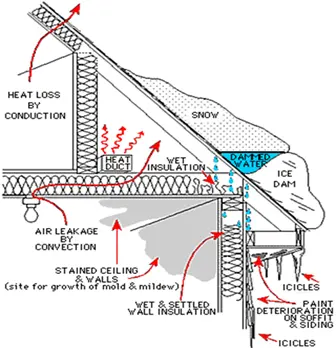
Ice dams are a serious winter problem that can cause significant water damage to your home. When snow melts and refreezes at your roof's edge, it creates a barrier that traps water underneath, leading to costly leaks and structural damage. At PRIME Remediation, we specialize in ice dam removal and prevention, protecting your home from water intrusion and the mold growth that follows. Our expert team uses proven techniques to safely remove ice dams and implement preventative solutions to keep your home safe all winter long.
What Is an Ice Dam?
An ice dam is a ridge of ice that forms at the lower edge of a roof and prevents water produced by melting snow from draining off the roof. The water that backs up behind the dam can leak into a building and cause damage to walls, ceilings, insulation, and other areas.
What Causes Ice Dams?
Non-uniform roof surface temperatures lead to ice dams. Heat loss from a house, snow-covered roofs and outside temperature interact and lead to ice dam formation. For ice dams to form, there must be snow on the roof, and, at the same time, the upper portions of the roof's surface must be above 32 degrees F, while lower surfaces are below 32 degrees F. For a portion of the roof to be below 32 degrees F, outside temperatures must also be below 32 degrees F. (When we say temperatures above or below 32 degrees F, we are talking about average temperatures over sustained periods of time.)
The snow on a roof surface that is above 32 degrees F will melt. As water flows down the roof, it reaches the portion of the roof that is below 32 degrees F and freezes. This creates an ice dam.
The dam grows as it is fed by the melting snow above it, but it will limit itself to the portions of the roof that are, on the average, below 32 degrees F. So the water above backs up behind the ice dam and remains a liquid. This water finds cracks and openings in the exterior roof covering and flows into the attic space. In the most common case, the water simply backs up and flows under the shingles. From the attic, it could move into exterior walls or through the ceiling insulation and stain the ceiling finish.