

Asbestos Glue: How to Identify Floor Tiles and Black Mastic
Asbestos is commonplace in any house or building built before the 1980s, with asbestos flooring tiles and black mastic (aka asbestos glue) being two of the biggest offenders.
With asbestos linked to cancers, breathing problems, and other lifelong health effects, it’s important to identify any Asbestos floor tiles and black mastic asbestos quickly, so you can address them ASAP and make your space totally safe.
What Are Asbestos Floor Tiles?
Asbestos floor tiles were building materials commonly installed in both residential homes and commercial buildings from the early 1920s until the 1980s, when asbestos was banned in the United States.
Because asbestos was lightweight, fireproof, and affordable, it was used throughout the construction industry and was a popular material for tiles in kitchens, bathrooms, foyers, and commercial buildings.
How to Identify Asbestos Tile Or Asbestos Glue
There isn’t a way to positively ID any asbestos building material by sight alone. For that, you’ll need a lab test from a certified asbestos inspector. But there are factors that can give you a hint.
For instance, asbestos floor tiles were usually installed in 9x9 sheets, although 12x12 or 18x18 were also common sizes. If a vintage floor tile fits the time period when asbestos was used, and the tiles are the right size, that’s a strong indication you’re dealing with asbestos tiles.
Beyond the size and age, other indications of asbestos tile include:
- Yellowish discoloration
- Brittle, rigid texture
- Patterns that go all the way through the tile, rather than being printed on top
- Visible black mastic glue beneath the tiles.
What Is Black Mastic?
Black mastic, AKA asbestos glue, is a kind of adhesive used during the asbestos era of construction in the 20th century.
It was used primarily to glue asbestos floor tiles and sheets of linoleum to subfloors. But it was also common in areas like baseboards, stair trims, roofing, or ductwork.
What Does Asbestos Glue Look Like?
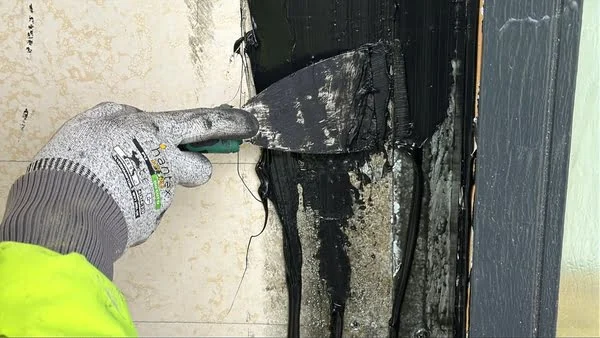
A popular question from homeowners is what does black mastic look like. Like the name suggests, black mastic has a black or deep brown shade. Depending on how long ago it was laid, it might still be tacky and tarry or have hardened into a brittle, smooth texture.
Again, the most common place to find it is under tiles, just above the subfloor, but you might encounter it beneath any type of construction material glued down in an older house.
Does All Black Mastic Contain Asbestos?
No, not always. But asbestos was an extremely common ingredient in pre-1980 mastic formulas. So, if the flooring was installed before asbestos was formally banned, it’s fairly safe to assume there’s asbestos in the black mastic.
A test from a professional asbestos abatement company can help you make a definitive determination, but to stay on the safe side, treat older black mastic like it contains asbestos anyway.
Is Black Mastic Asbestos Glue Dangerous?
That depends on its state. Because black mastic has a sticky texture, it doesn’t release airborne asbestos as easily as other types of asbestos, like the flooring tiles themselves. If you leave intact black mastic alone, then normal foot traffic isn’t likely to disperse asbestos particles.
However, if the black mastic has grown brittle and is crumbling, then it’s at risk of dispersing asbestos particles and needs to be addressed ASAP.
What to Do if You Have Asbestos Floor Tiles and Asbestos Glue
If you find out that the tiles in your house have asbestos, you’ll probably want to rip them out right away. But disturbing the tiles can actually be worse for your safety, since they can crumble and release particles throughout the space.
If the tiles and black mastic are intact and not crumbling or brittle, taking care of them can be as simple as laying new flooring on top of them. You can seal tiles and black mastic with a specialized asbestos sealant before adding your choice of new flooring on top.
You avoid the risk of spreading asbestos particles throughout your home or building, and encapsulation is a much simpler, more affordable process.
If the tiles are crumbling or the black mastic is flaky and brittle, it’s typically a better choice to have them professionally removed by a licensed asbestos contractor. Contractors are specially trained in techniques that prevent asbestos from spreading throughout the house, and possibly contaminating the air in other rooms.
You can learn more about the differences between asbestos encapsulation and removal here.
Asbestos Glue, Floor Tile & Black Mastic FAQ
When was black mastic banned?
Black mastic containing asbestos was banned in 1989 by the EPA. However, black mastic without asbestos is still in use today as an adhesive, and it’s perfectly safe in new builds and renovations.
Is it safe to walk on black mastic?
Generally, yes. If the black mastic is still intact and sealed beneath floor tiles that are also still in good shape, then walking on the tiles isn’t dangerous.
But if the mastic is exposed and crumbly, then you should avoid walking on it and look into encapsulating it as soon as possible.
A Rhode Island Asbestos Remediation Company
If you need to remediate black mastic and asbestos floor tiles in the New England area, PRIME Remediation is here for you.
We specialize in all remediation, with an expert team known for our efficiency and competitive pricing throughout the area. Contact us today to learn how we can make your space safe to live, work, and play in again.